Why the Upper East Side Makes City Living Feel So Easy and Relaxing

City living often gets described as loud, crowded, and tiring. Yet for many families, life in Manhattan can feel surprisingly calm. Not calm in the quiet-country-road sense, but calm in the “everything I need is right here” sense.
That is the part people sometimes miss.
A relaxing life is not only about space. It is also about reducing friction. Fewer long drives. Fewer parking battles. Fewer errands that take half a Saturday. Fewer moments where a simple lunch, playdate, or family visit turns into a full production.
That is where the Upper East Side has a way of winning people over. It offers the energy of New York, but with a daily rhythm that can feel steady, familiar, and easy to manage. Compared with a more car-centred life in Los Angeles, Manhattan can feel almost effortless once the routine clicks into place.
This is not about declaring one city better in every way. LA has sunshine, beaches, space, and a slower visual pace. But for people who value convenience, walkability, public transport, and neighbourhood routine, the Upper East Side makes a strong case for city living that feels genuinely relaxing.

Relaxation often starts with having less to organise
A lot of modern stress comes from logistics. Where do you park? How long will the drive take? Is there traffic on the way back? Can you fit in groceries before school pickup? Does a quick coffee mean finding a spot, paying for parking, and walking across a huge lot?
In much of LA, even simple plans can revolve around the car. The car becomes part of every decision. Leaving the house means calculating time, traffic, route, petrol, parking, and the mood of everyone sitting in the back seat.
On the Upper East Side, many of those calculations disappear.
Need milk, toothpaste, flowers, a birthday card, or a missing ingredient for dinner? There is a good chance one of those things is across the street or around the corner. That convenience changes the emotional weight of an errand. It stops feeling like a task and starts feeling like a five-minute reset.
There is something quietly comforting about being able to say, “I’ll be right back,” and mean it.
The same applies to everyday family life. Dry cleaning, pharmacy runs, school supplies, dog walks, coffee, a quick lunch, a bank stop, and a grocery top-up can all fit into the small gaps of the day. You do not have to build a schedule around them.
That matters more than people realise. When errands are smaller, days feel more open. When the basics are nearby, home feels better supported by the neighbourhood around it.
The Upper East Side is especially good at this because it has both residential calm and practical density. It is not only apartment buildings and museums. It is also bakeries, delis, supermarkets, stationery shops, pharmacies, bookshops, gyms, salons, playgrounds, and little places that become part of the weekly rhythm.
After a while, convenience becomes its own kind of comfort.
Manhattan makes movement feel simple
For many people moving from LA or comparing the two cities, transport is the biggest shift. In Los Angeles, the car often feels like the default. In Manhattan, walking, buses, subways, taxis, and rideshares all work together as a kind of menu. You choose what suits the moment.
That choice can feel freeing.
On the Upper East Side, public transport makes it easier to visit family and friends without planning the whole day around a drive. The subway can take you downtown, across to other neighbourhoods, or towards major hubs. Buses are especially useful for crosstown trips and for anyone who prefers staying above ground. For shorter distances, walking often wins.
This is one reason Why the Upper East Side Makes City Living Feel So Easy and Relaxing in daily practice, not just as an idea. You can move through the city in several ways, depending on the weather, the time, and who is with you.
Going to see grandparents on the West Side? A bus and a short walk may be enough. Meeting friends downtown? The subway is likely the simplest choice. Taking children to a birthday party, museum, or lunch? You can often avoid the stress of loading everyone into a car and sitting in traffic.
Public transport also makes social life feel more possible. Visiting someone does not need to involve checking drive times at three different hours of the day. A casual plan can stay casual.
There is also a subtle emotional benefit to not always being behind the wheel. On a bus or train, you can sit with your child, chat, read, people-watch, or simply be quiet for a few stops. Walking gives the day natural pauses. You notice shop windows, dogs, building details, flowers outside a bodega, or the same neighbour you saw yesterday.
Manhattan movement has its irritations, of course. Trains can be delayed. Buses can be full. Pavements can feel crowded. But the system gives options, and options make life feel less trapped.
In LA, a bad traffic day can swallow the plan. In Manhattan, a small change in route can often save it.
Cafes and lunch spots turn the neighbourhood into an extension of home
One of the quiet pleasures of Upper East Side life is the sheer number of places to pause.
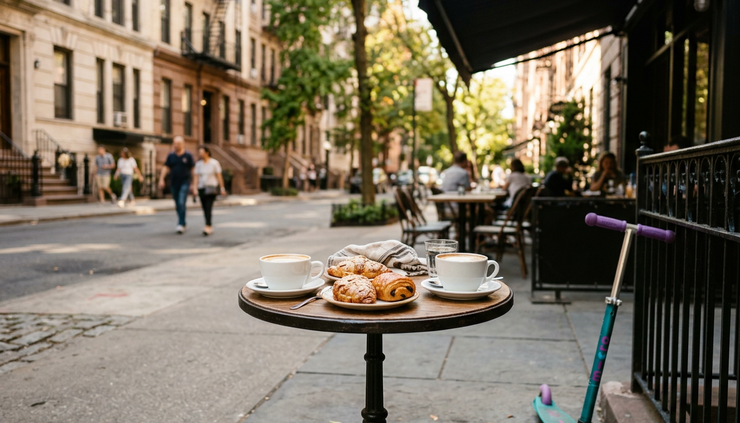
There are cafes for the early coffee after school drop-off. There are quick lunch spots for a sandwich, salad, soup, sushi, bagel, or slice of pizza. There are bakeries for an after-school treat and casual restaurants that can rescue an evening when cooking feels like too much.
This abundance does more than feed people. It softens the day.
A neighbourhood with many easy food options gives families room to be flexible. If the morning runs late, breakfast can happen on the way. If a playdate stretches longer than expected, lunch is nearby. If friends pop into the area, meeting them does not require a booking, a drive, or a long wait.
The pleasure is partly practical and partly emotional. Having a few favourite places nearby makes a big city feel personal. The person at the cafe remembers the usual order. The lunch counter recognises the child who always asks for the same muffin. The corner spot becomes the place where rainy afternoons feel manageable.
That kind of familiarity can be deeply relaxing.
It also helps that many Upper East Side streets have a residential feel. You can step out for coffee without feeling like you have entered a tourist zone or a nightlife district. The neighbourhood has energy, but much of it is daily-life energy. School bags, prams, dogs, older neighbours, runners, commuters, and people picking up dinner.
There is comfort in seeing other people do ordinary things.
In LA, the best lunch place might be fifteen minutes away, or forty-five if traffic turns. In Manhattan, the best choice might be the place you pass on the way home. That difference changes how often you say yes to small pleasures.
A quick cappuccino. A ten-minute soup. A pastry on the walk home. A casual lunch with a friend who happens to be nearby.
These small moments are not glamorous, but they make life feel easier.
Children often adapt faster than adults expect
Parents sometimes worry that city life will feel too intense for children. The noise, the crowds, the apartment living, the lack of a big garden. Those concerns are understandable, especially for families used to more space.
Yet children often adapt to the Upper East Side rhythm with surprising ease.
They learn the neighbourhood quickly. They know which corner has the best bagels, which playground has the best swings, which bus stop gets them to a friend’s apartment, and which shop has the treat they like after school. Their world becomes walkable and knowable.
That can create a strong sense of independence, even in small ways. A child may not be roaming alone at a young age, but they learn how the city works. They understand blocks, crossings, building numbers, doormen, bus routes, train stops, and local landmarks. They become aware of people around them. They learn patience in queues and confidence in shared spaces.
City children also get used to variety. They hear different languages on the pavement. They see people of different ages, styles, cultures, and routines every day. They learn that life can be busy without being scary, and full without being overwhelming.
The easy lifestyle becomes something they appreciate because it affects their days directly.
A playground can be a short walk away. Friends may live nearby. A rainy afternoon can turn into a museum visit, a library stop, or hot chocolate around the corner. A family outing does not always need snacks packed for a long car ride because food, toilets, and transport are close at hand.
Parents benefit too. Less time in traffic often means more time together. A school pickup can become a walk and a chat instead of a tired drive. A weekend morning can include breakfast out, a park visit, errands, and home again before the day has slipped away.
Children notice when adults are less stressed. They may not say it that way, but they feel the difference. A parent who is not hunting for parking or sitting in gridlock has more patience for the small things.
That is one of the quiet gifts of a walkable city life.
The Upper East Side has a gentle routine inside a big city
The Upper East Side works well for people who want Manhattan access without feeling like every day is a race. It has major cultural landmarks, Central Park nearby, good transport links, and plenty of restaurants and shops. It also has a strong neighbourhood feeling.
That combination matters.
A relaxing city life does not mean escaping the city. It means building a routine that makes the city work for you. On the Upper East Side, that routine can be simple:
Walk to school, the shop, the park, or the subway.
Pick up lunch without making a plan.
Use the bus for an easy crosstown visit.
Meet friends without a long drive.
Let children grow familiar with the streets around home.
Keep daily errands small and manageable.
Compared with LA, Manhattan asks for less driving and often gives back more time in the day. The trade-off is less private space, more shared space, and a willingness to live closer to other people. For many families, that trade-off feels worthwhile because the neighbourhood itself becomes part of the home.
The pavement becomes the hallway. The cafe becomes the breakfast nook. The park becomes the garden. The bus route becomes the easy connection to people you love.
That is what makes city living relaxing in a way that can be hard to explain until you have lived it. It is not silent. It is not always slow. It is not free of inconvenience.
But it can be beautifully easy.
And sometimes, the most relaxing thing in the world is knowing that whatever you need next is just across the street.


Comments